Articel Details
What Is a Two-Component Adhesive Formulation? A/B Components, Fillers & Examples
wo-component adhesives consist of an A component (main resin/monomer) and a B component (curing agent/initiator). This structured guide explains the formulation logic, A/B pairing, mixing ratio, pot l
11-11-26
Two-Component Adhesive Formulation: A/B Components, Fillers, and Classic AB Adhesive Examples
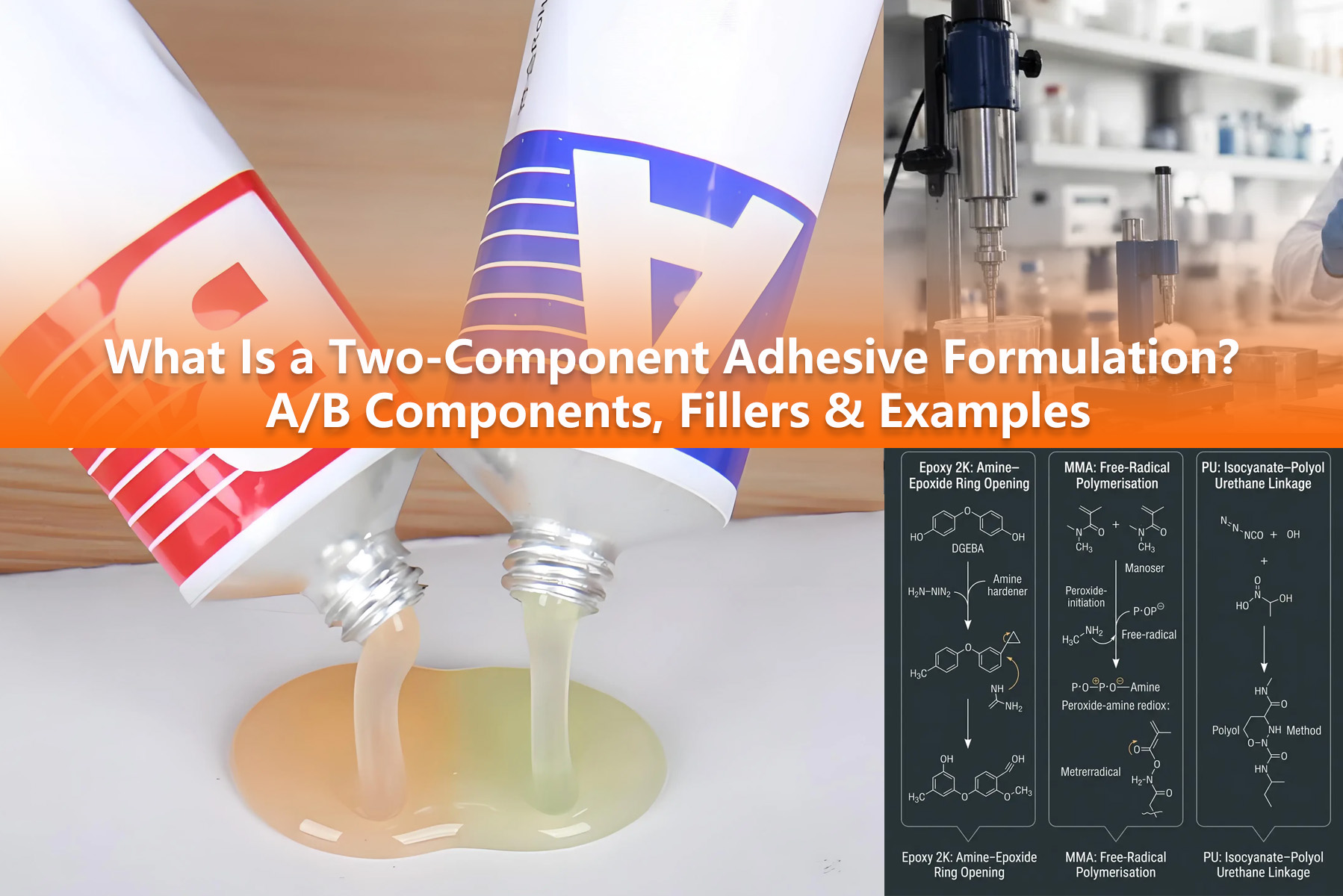
Two-component adhesives are commonly known as AB adhesives. They require the A and B components to be mixed at a specified ratio before use, after which a chemical reaction cures the adhesive. Two-component adhesives are widely used in construction, electronics, metal bonding, ceramic bonding, and certain structural bonding applications. It is important to note that “AB adhesive” is a general term for two-component adhesives; epoxy AB adhesive is only one common type and does not represent all AB adhesives.
So what is an AB adhesive formulation composed of? This article explains two-component adhesive formulations from three perspectives—the A component, the B component, and fillers—and summarizes three classic AB adhesive formulation examples to help readers understand the formulation logic.
Key Takeaways
● A two-component adhesive generally consists of an A component, a B component, and fillers/additives.
● The A component usually contains epoxy resin or acrylic-modified epoxy as the main body, together with solvents or diluents to adjust application properties.
● The B component is usually a curing agent, catalyst, or modified amine, such as aliphatic amines, cycloaliphatic amines, aromatic amines, polyamides, anhydrides, resin-type curing agents, tertiary amines, and aromatic curing agents.
● Common fillers include quartz powder, silica powder, aluminum hydroxide, calcium carbonate, talc, aluminum oxide, mica powder, graphite powder, metal powders, and fibrous fillers.
● Classic AB adhesive formulations must be mixed at a scientifically determined ratio. Actual production should follow the supplier’s TDS and experimental validation.
1. Composition of Two-Component Adhesives
1.1 A Component: Resin Matrix and Application Adjusters
The A component is the main component of a two-component adhesive. It usually contains epoxy resin or acrylic-modified epoxy, which provides bonding performance, mechanical properties, and the crosslinked network after curing. To adjust viscosity, workability, and penetration, the A component may also contain solvents or diluents such as ethanol, propanol, propylene glycol, isopropanol, ethylene glycol monobutyl ether, acetone, butanone, benzene, and xylene.
It should be emphasized that solvents and diluents are formulation adjusters. Whether to use them and which type to use depends on environmental requirements, application conditions, and the bonding substrate.
1.2 B Component: Curing Agent, Catalyst, or Modified Amine
The B component is generally a curing agent, catalyst, or modified amine that triggers curing of the A component. Common types include aliphatic amines, cycloaliphatic amines, aromatic amines, polyamides, anhydrides, resin-type curing agents, tertiary amines, and aromatic curing agents.
The A and B components must be packaged separately and mixed at the recommended ratio before use. Deviation from the mixing ratio may cause incomplete curing, reduced strength, or a tacky surface.
1.3 Fillers: Important Components for Performance and Cost Adjustment
Fillers are often added to two-component adhesives to adjust viscosity, rheology, density, thermal conductivity, shrinkage, and cost. Common fillers include asbestos or glass fiber, quartz powder, porcelain powder, iron powder, cement, emery, aluminum oxide, silica gel powder, aluminum powder, copper powder, graphite powder, talc, and mica powder.
In practical formulations, the selection and particle size distribution of fillers significantly affect the workability, settling behavior, and final mechanical properties of the adhesive.
2. Two-Component Adhesive Composition Table
| Component | Main Role | Common Ingredients |
|---|---|---|
| A component | Provides the bonding matrix and cured network | Bisphenol A epoxy resin, acrylic-modified epoxy, reactive diluents, solvents, toughening agents |
| B component | Triggers curing or crosslinking | Aliphatic amines, cycloaliphatic amines, aromatic amines, polyamides, anhydrides, tertiary amines, modified amines, catalysts |
| Fillers | Adjust viscosity, cost, thermal conductivity, shrinkage, etc. | Aluminum hydroxide, silica powder, quartz powder, calcium carbonate, talc, aluminum oxide, mica powder, metal powders, fibers |
| Additives | Improve application and stability | Defoamers, coupling agents, antioxidants, fumed silica, pigments |
3. Classic Two-Component Adhesive Formulation Examples
The following formulations are organized based on the user-provided original text, with obvious terminology issues standardized for readability. These formulations are literature/market examples, not directly production-ready recipes. The original percentage ranges may not strictly sum to 100%; actual applications require re-normalization and experimental validation.
Formulation 1: Epoxy AB Adhesive Example
| Component | Ingredient | Ratio |
|---|---|---|
| A component | Bisphenol A epoxy resin | 50.0–55.0% |
| A component | Aluminum hydroxide (800 mesh) | 20.0–25.0% |
| A component | Silica powder | 15.0–20.0% |
| A component | Iron oxide | 1.0–3.0% |
| B component | Methyl tetrahydrophthalic anhydride (original: “methyl tetrahydrobenzene”) | 18.0–25.0% |
| B component | N,N-dimethylamine-type accelerator (as in original; verify exact grade) | 1.5–2.5% |
| B component | Polyester polyurethane (original: “polyester polyurethane”) | 5.0–7.0% |
| B component | BHT | 1.0–1.5% |
| B component | Aluminum hydroxide (800 mesh) | 15.0–20.0% |
| B component | Silica powder (1000 mesh) | 40.0–50.0% |
Formulation 2: Epoxy AB Adhesive Example
| Component | Ingredient | Ratio |
|---|---|---|
| A component | Bisphenol A epoxy resin (original: “bisphenol A oxygen resin”) | 40.0–45.0% |
| A component | Silicic acid/siliceous filler (as in original) | 35.0–45.0% |
| A component | Calcium carbonate | 5.0–10.0% |
| A component | KH560 coupling agent | 0.5–1.0% |
| A component | Silicon dioxide (original: “silicon dioxide brick,” likely a typo) | 2.0–5.0% |
| B component | Tetrahydrophthalic anhydride (original: “tetrahydrophthalic acid”) | 8.0–10.0% |
| B component | Methyl tetrahydrophthalic anhydride (original: “methyl tetrahydrophthalic acid”) | 20.0–25.0% |
| B component | Aminoethylpiperazine (original: “aminoethyl piperazine”) | 1.0–2.0% |
| B component | Silicic acid/siliceous filler | 35.0–45.0% |
| B component | Calcium carbonate | 5.0–10.0% |
Formulation 3: Epoxy AB Adhesive Example
| Component | Ingredient | Ratio |
|---|---|---|
| A component | Liquid bisphenol A epoxy resin | 60% |
| A component | 1,4-Butanediol diglycidyl ether (original: “diglycidyl ether”) | 4–6% |
| A component | Defoamer BYK-A-555 (original: “BYKA-555”) | 0–1% |
| A component | Aluminum hydroxide powder | 30.35% |
| A component | Fumed silica | 1.5–2% |
| B component | Liquid polyamide resin | 36–40% |
| B component | Amine-terminated liquid nitrile rubber (original: “amine-terminated liquid nitrile rubber”) | 10–12% |
| B component | Aluminum hydroxide powder | 20–25% |
| B component | Talc | 25–30% |
| B component | Fumed silica | 0–1.5% |
4. How Should These AB Adhesive Formulations Be Understood?
1.The A/B ratio must be accurate: Two-component adhesives rely on stoichiometric reactions. Ratio deviation affects curing degree and final strength.
2.Formulation ranges are not fixed values: The ranges for different raw materials in the same formulation must be optimized according to viscosity, curing speed, strength, and cost.
3.Fillers affect workability: The particle size and oil absorption of fillers such as aluminum hydroxide, silica powder, calcium carbonate, and talc affect adhesive consistency and settling.
4.Terminology and grades should follow the TDS: Some terms in the original text appear to be typos. Actual purchasing and production should follow the supplier’s technical data sheet.
5.Run small-scale tests before scale-up: Classic formulations can serve as a starting point, but before production, validate mixing ratio, pot life, curing conditions, bonding substrate, and weather resistance.
5. FAQ: Common Questions About Two-Component Adhesive Formulations
Q1: Is AB adhesive the same as epoxy adhesive?
Not exactly. AB adhesive is a general term for two-component adhesives. Epoxy AB adhesive is one common type; there are also polyurethane AB adhesives, acrylic AB adhesives, and two-component silicone adhesives.
Q2: What are the A and B components of a two-component adhesive?
The A component is usually the resin matrix and application adjusters, while the B component is usually the curing agent, catalyst, or modified amine. Specific ingredients vary by chemical type.
Q3: What role do fillers play in an AB adhesive formulation?
Fillers adjust viscosity, rheology, density, thermal conductivity, shrinkage, and cost. Common fillers include aluminum hydroxide, silica powder, calcium carbonate, talc, aluminum oxide, and mica powder.
Q4: Can classic AB adhesive formulations be used directly for production?
Direct production is not recommended. Classic formulations can serve as a starting point for formulation design, but they must be tested and validated based on raw material grades, substrates, curing conditions, and performance targets.
Q5: How long can a two-component adhesive be used after mixing?
It depends on the pot life. Higher ambient temperature and larger mixed batches usually shorten pot life. Mix only what is needed and use immediately.
6. Conclusion
The composition of a two-component adhesive mainly includes an A component resin matrix, a B component curing agent/catalyst, and fillers/additives. The A component provides the bonding matrix, the B component triggers curing, and fillers adjust viscosity, cost, and functional performance. The three classic AB adhesive formulations summarized in this article can serve as references for understanding the formulation logic of two-component adhesives. However, actual production must be validated around mixing ratio, pot life, curing conditions, substrates, and performance requirements.
Two-component adhesives, commonly called AB adhesives, generally consist of an A component resin matrix, a B component curing agent/catalyst, and fillers/additives. Classic formulations can serve as a starting point for formulation design, but practical applications must be validated according to mixing ratio, pot life, curing conditions, and substrate performance.
Related Topics: two-component adhesive formulation · AB adhesive formulation · two-component adhesive composition · epoxy AB adhesive formula · two-component adhesive fillers · A/B components · mixing ratio · pot life
Recent Blog Here
Related Articles
Articel
What Does the Pressure Tank Do in an AB Adhesive Dispensing Filling Machine?
Learn how pressure tanks in AB adhesive dispensing machines isolate A/B componen...
Articel
Adhesive Bonding Methods: A Practical Guide to the 10 Dominant Techniques (2026)
Compare 10 adhesive bonding methods—instant, structural, hot melt, pressure-sens...
Articel
What Is a Two-Component Adhesive Formulation? A/B Components, Fillers & Examples
wo-component adhesives consist of an A component (main resin/monomer) and a B co...
Articel
High-Viscosity Two-Component Adhesive Filling Keeps Going Wrong? One Press-plate Filling Solution for Both 50 ml and 400 ml Cartridges
WEFILL-CAR-AB-F005-400-50 follower-plate filling machine handles high-viscosity ...
Articel
Mastering UV Adhesive Dispensing Machines to Boost Efficiency: Best Practices and the WEFILL-SYR-SF003 Breakthrough
Learn how to operate UV adhesive dispensing machines correctly, improve filling ...