Articel Details
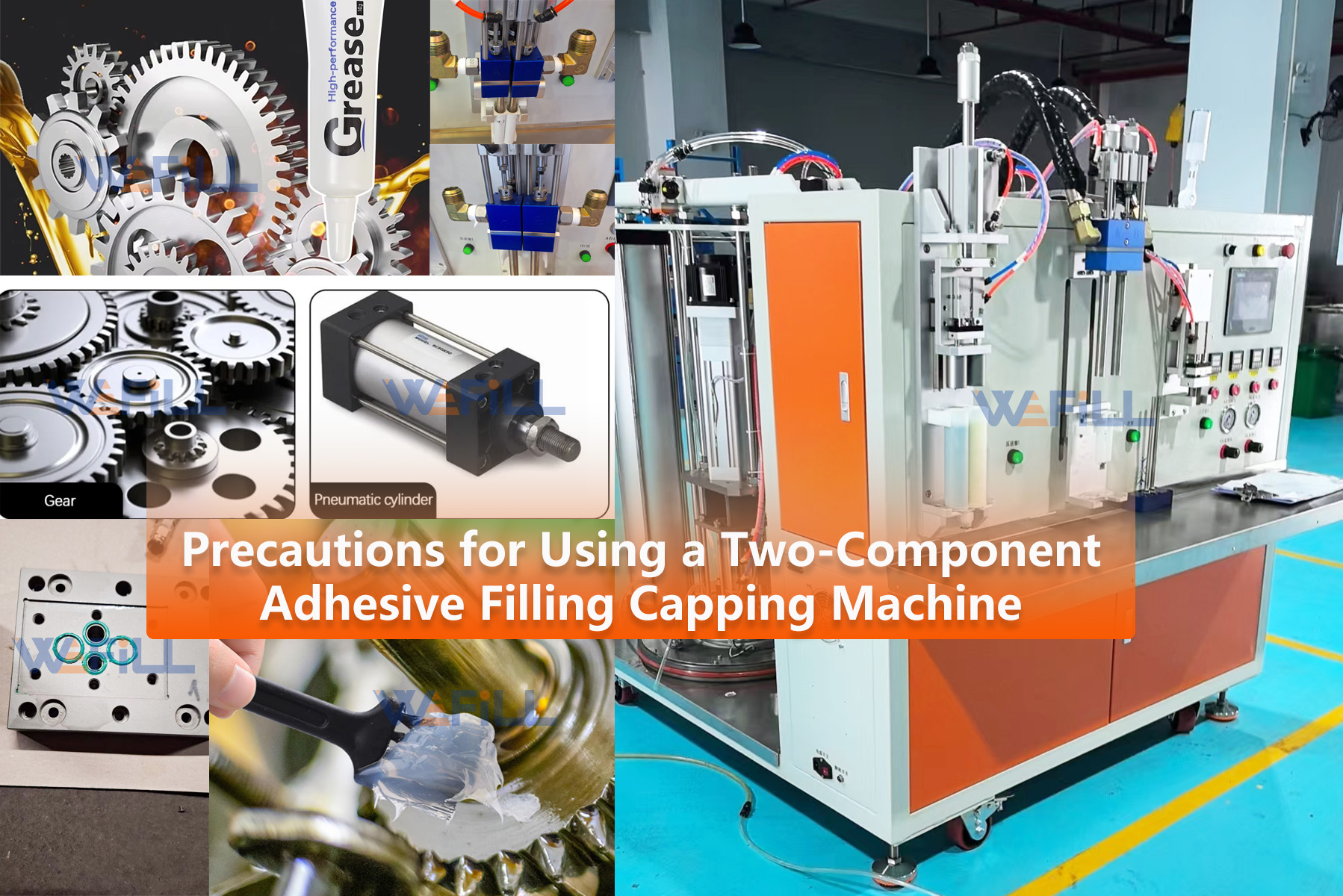
Precautions for Using a Two-Component Adhesive Filling Capping Machine
Learn 8 key precautions for two-component adhesive dispensing machines and discover WEFILL-CAR-AB-F005 for stable high-viscosity adhesive cartridge filling.
31-10-26
Precautions for Using a Two-Component Adhesive Filling Capping Machine and a Recommended Filling Solution for High-Viscosity Adhesives
Two-component adhesive dispensing machines are widely used in industrial production and manufacturing for automatic mixing and dispensing of two-component adhesives. They can improve production efficiency and product quality. However, long-term stable operation depends not only on standardized daily operation but also on whether the equipment is properly matched to the actual adhesive characteristics. This is especially true for high-viscosity adhesives, where unstable feeding, pipe clogging, and ratio deviation are common pain points. This article summarizes 8 precautions for using two-component adhesive dispensing machines and recommends an equipment solution for high-viscosity adhesive cartridge filling.
I. Precautions for Using a Two-Component Adhesive Dispensing Machine
1. Operator Training
Before using the equipment, all operators should receive professional training to understand the equipment structure, working principle, operating procedures, and emergency handling methods. Operators should be familiar with the control panel, buttons, and indicator lights to avoid misoperation.
2. Safety Protection
Operators should wear appropriate personal protective equipment such as safety glasses, gloves, and protective clothing to prevent adhesive from contacting the skin or eyes. The operating environment should be well ventilated to avoid inhalation of harmful gases.
3. Adhesive Selection
Select adhesive types suitable for the two-component adhesive dispensing machine and ensure compatibility with the equipment. When selecting adhesives, consider viscosity, flowability, and chemical characteristics to ensure that the dispensing process will not clog pipes or damage the equipment. For high-viscosity adhesives, particular attention should be paid to whether the feeding method and metering method are properly matched.
4. Cleaning and Maintenance
Regular cleaning and maintenance are key to ensuring normal operation. Clean all equipment components, especially the parts in contact with the adhesive, to prevent residue accumulation. Regularly inspect key components such as pipes, valves, and pumps to ensure they are unobstructed.
5. Calibration and Commissioning
When starting to use a new machine or changing the adhesive type, calibration and commissioning are required to ensure dispensing accuracy and stability. Adjust parameters such as flow ratio and pressure according to the adhesive characteristics and flow requirements.
6. Emergency Handling
Prepare an emergency plan in advance for situations such as pump or pipe clogging and leakage. Operators should know how to shut down the equipment in an emergency and must not directly touch the adhesive with their hands. In an emergency, disconnect the power supply quickly and take measures according to the emergency plan.
7. Environmental Protection
The operation of the equipment may generate waste such as adhesive residue and cleaning agents. Waste should be properly handled in accordance with local environmental regulations to ensure the environment is not polluted.
8. Production Records
Keep detailed production records, including adhesive batch number, dispensing volume, time, and other information. This helps trace product quality and troubleshoot problems in a timely manner.
II. Key Selection Considerations for High-Viscosity Adhesives
Among the above precautions, "adhesive selection" and "calibration and commissioning" are particularly critical for high-viscosity two-component adhesives. Traditional two-component dispensing machines often face problems such as unstable feeding, air entrapment, and material waste when handling high-viscosity epoxy anchor adhesives. If the feeding method of the equipment does not match the adhesive viscosity, even if operators strictly follow the procedures, metering fluctuations, pipe clogging, and ratio deviations may still occur.
Therefore, for high-viscosity, fixed-ratio two-component adhesive cartridge filling, priority should be given to dedicated equipment using pressure plate feeding and metering pump metering.
III. Recommended Equipment: WEFILL-CAR-AB-F005 Pressure Plate Feeding + Metering Pump Filling Machine
WEFILL specializes in the production of two-component dispensing equipment, one-component dispensing equipment, two-component adhesive filling equipment, one-component adhesive filling equipment, grease filling equipment, silicone sealant filling equipment, and supporting labeling machines, centrifuges, potting machines, and corresponding packaging materials. Product continuity and stability are our core pursuit.
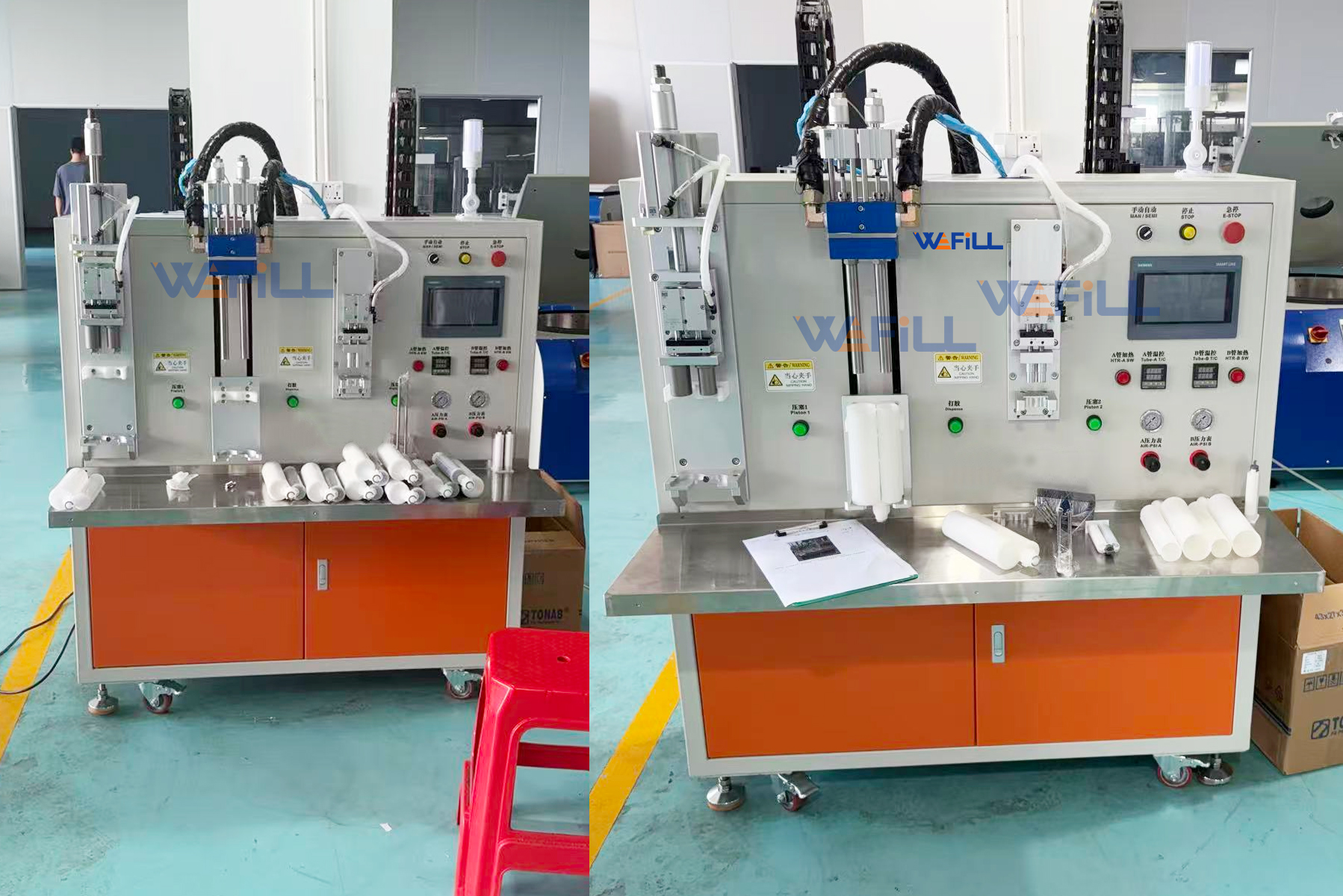
In the WEFILL product line, the WEFILL-CAR-AB-F005 Pressure Plate Feeding + Metering Pump Filling Machine is designed to address the pain points of high-viscosity adhesive filling and is worthy of priority attention. This model is designed for epoxy adhesive cartridge filling in 50ml, 200ml, 400ml, and 600ml at a 1:1 ratio, as well as 50ml/75ml/250ml/490ml at a 10:1 ratio.
Core Features
Pressure Plate Feeding for Stable High-Viscosity Material Handling
The equipment adopts a pressure plate feeding system to smoothly push high-viscosity adhesive into the metering unit, avoiding feeding interruptions or metering fluctuations caused by poor material flowability. This directly addresses the concern that "when adhesive viscosity is high and flowability is poor, it is easy to clog pipes or damage the equipment," and it also echoes the requirements for adhesive compatibility and stable feeding emphasized in the precautions.
Integrated Filling and Capping
This model integrates precision filling and automatic capping functions, completing the continuous operation from metering and filling to sealing on a single machine. It is suitable for production line scenarios with requirements for efficiency and consistency. Reducing intermediate transfer steps also helps lower the risk of adhesive exposure and contamination.
Application Scenarios
WEFILL-CAR-AB-F005 is mainly aimed at the chemical and electronic adhesive industries, with typical applications including epoxy resin adhesives, PU, and MMA acrylics. If your product line involves high-viscosity, fixed-ratio two-component adhesive cartridge filling, this equipment is highly compatible.
IV. Conclusion
Two-component adhesive dispensing machines play an important role in industrial production. To ensure safe and efficient operation, operators need to strictly follow the usage precautions. Through professional training, reasonable operation, and regular maintenance, long-term stable equipment operation can be ensured, production efficiency and product quality can be improved, and waste handling and environmental protection can be properly managed.
For high-viscosity two-component adhesive filling, equipment selection is equally critical. WEFILL-CAR-AB-F005, with pressure plate feeding and metering pump metering as its core, provides a dedicated solution for practical pain points such as unstable feeding, pipe clogging, and ratio deviation. If you are selecting equipment for high-viscosity two-component adhesive filling, you can further confirm the equipment configuration based on adhesive type, viscosity range, cartridge capacity, and mixing ratio. Product continuity and stability are the core pursuit of WEFILL.
Recent Blog Here
Related Articles
Articel
What Does the Pressure Tank Do in an AB Adhesive Dispensing Filling Machine?
Learn how pressure tanks in AB adhesive dispensing machines isolate A/B componen...
Articel
Adhesive Bonding Methods: A Practical Guide to the 10 Dominant Techniques (2026)
Compare 10 adhesive bonding methods—instant, structural, hot melt, pressure-sens...
Articel
What Is a Two-Component Adhesive Formulation? A/B Components, Fillers & Examples
wo-component adhesives consist of an A component (main resin/monomer) and a B co...
Articel
High-Viscosity Two-Component Adhesive Filling Keeps Going Wrong? One Press-plate Filling Solution for Both 50 ml and 400 ml Cartridges
WEFILL-CAR-AB-F005-400-50 follower-plate filling machine handles high-viscosity ...
Articel
Mastering UV Adhesive Dispensing Machines to Boost Efficiency: Best Practices and the WEFILL-SYR-SF003 Breakthrough
Learn how to operate UV adhesive dispensing machines correctly, improve filling ...