Articel Details
How Seasonal Changes Affect Adhesive Curing Speed and Strength
Humidity and temperature affect adhesive curing speed and strength. Discover seasonal process tips for two-component polyurethane lamination.
17-10-26
How Seasonal Changes Affect Adhesive Curing Speed and Strength
For companies engaged in flexible packaging lamination and adhesive applications, the performance of two-component polyurethane adhesives depends not only on formulation and equipment, but also heavily on ambient temperature and humidity. As seasons change, fine-tuning the adhesive application process becomes essential to achieve consistent lamination quality.
Simply put, the seasonal factors affecting the lamination process are mainly ambient humidity and temperature. In spring and summer, especially during the plum rain season, relative humidity can be extremely high—even reaching saturation. In autumn and winter, the air becomes dry with low humidity. As for temperature, summer can be much hotter than winter. In southern China where indoor heating is uncommon, the difference can reach as much as 30–40°C.
If these differences are overlooked, the following problems are likely to occur during lamination.
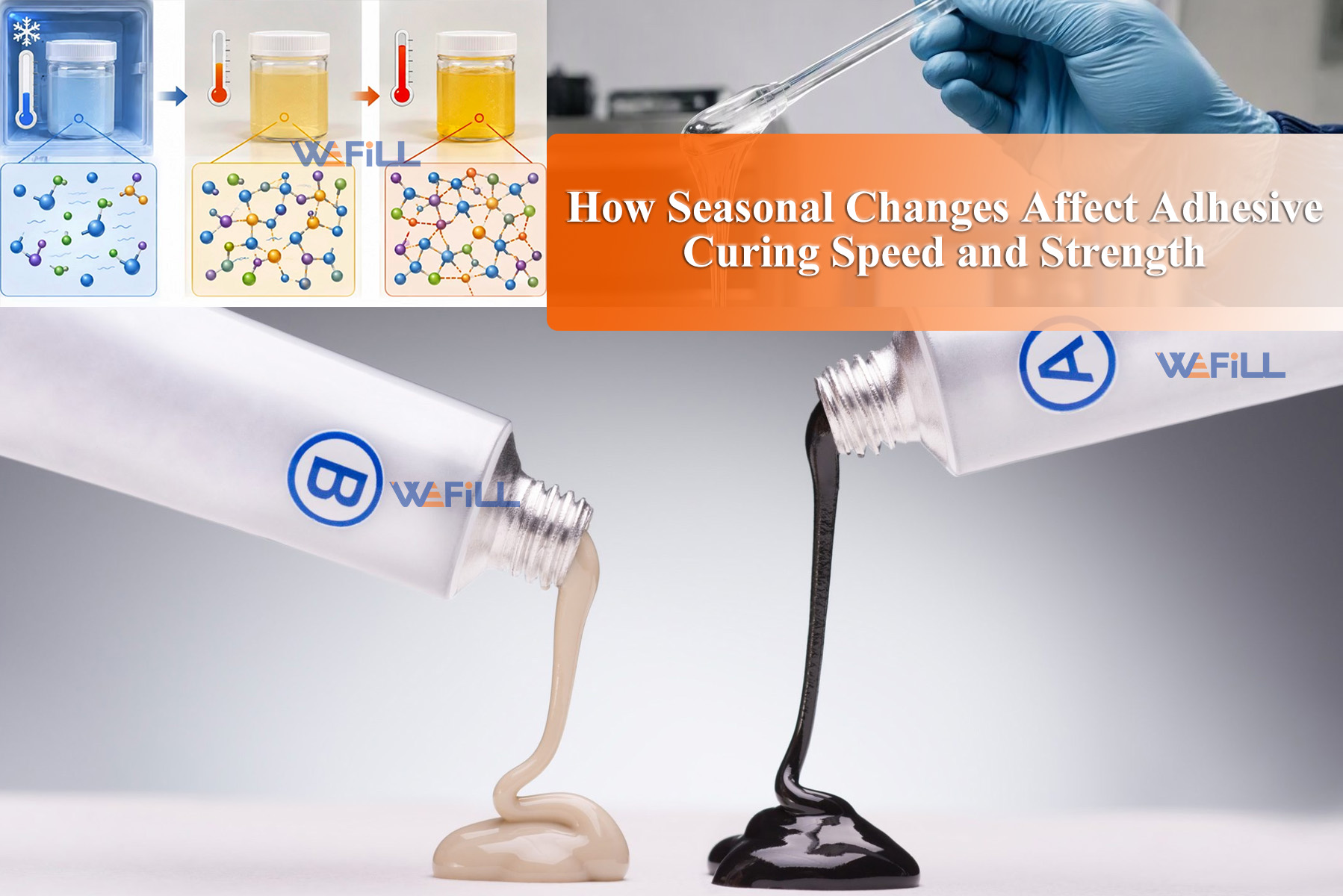
In Humid Conditions
● The adhesive often cures incompletely, remaining tacky—what is commonly called "not dry through"
● In severe cases, stringing can be observed during peel testing of the laminated film
● This is especially pronounced when using highly moisture-absorbent films such as nylon
In addition, moisture in the air can condense on the gravure roller, carrying water into the adhesive pan. Over time, the adhesive gradually turns from clear to cloudy and whitish, eventually losing its bonding capability. Hot and humid conditions also make adhesive storage difficult. If the mixed working adhesive is not used up within the day, it often turns white and forms gel (jelly-like) overnight.
In contrast, during cold winter days, leftover working adhesive can remain clear and fluid overnight, and can even be directly used on the machine without blending in batches with freshly mixed adhesive.
On the other hand, in cold winter conditions, the adhesive becomes more viscous and less fluid. When the laminator runs at high speed, large amounts of bubbles tend to accumulate on the adhesive surface and at the edges of the gravure roller. This can cause bubble transfer and insufficient adhesive application, ultimately affecting bonding strength. Meanwhile, poor flow and dispersion lead to deteriorated appearance of the laminated film—visible flow marks and an orange-peel texture. When laminating aluminum foil or metallized film, if the printed surface has large areas of white or light-colored ink, small white spots and speckles are more likely to form.
Moreover, due to low winter temperatures, the temperature difference between the curing room and the outside environment is significant. If insulation measures are inadequate, heat dissipates much faster than in hot summer, often preventing the curing room from reaching its set temperature (typically 50°C). As a result, curing effectiveness is compromised, and bonding strength may be lower than in summer under the same curing time.
Root Causes: How Moisture and Temperature Affect Adhesives
To understand these phenomena, we need to examine how moisture and temperature affect the adhesive.
First, for two-component polyurethane adhesives, water—like the main component (polyester/polyether polyol)—can react with the NCO groups in the curing agent. It is estimated that 1g of water can consume 26–32g of curing agent. Of course, this is based on pure reaction weight ratio. In practice, water mixed into the working adhesive competes with the main agent for the curing agent. Regardless of how much water actually reacts, it undoubtedly consumes curing agent, preventing it from reacting with the main agent at the designed ratio. This leads to incomplete curing and residual tackiness.
Adhesive viscosity and reactivity are closely related to temperature. The viscosity values provided by adhesive manufacturers are measured with a rotational viscometer at a standard temperature of 25°C. This means that in actual use, the working environment temperature may be 10+ degrees higher in summer, or 20+ degrees lower in winter. Adhesive viscosity is inversely related to temperature: at higher temperatures, viscosity is lower and flow/dispersion is better; at lower temperatures, viscosity is higher and leveling is poorer.
Additionally, the cross-linking and curing reaction between the two components of the adhesive is slower at low temperatures and faster at high temperatures. This is precisely why a curing room is needed—to accelerate the curing reaction and improve production efficiency.
Process Adjustment Recommendations for Seasonal Changes
Based on the above analysis, the following adjustments can be made when using two-component polyurethane adhesives for lamination.
When Air Is Humid and Temperature Is High
● Increase curing agent dosage by 10%–20% to compensate for moisture consumption
● Regularly wipe off condensed water droplets on the laminator with dry cotton cloth or rags to prevent them from dripping into the adhesive pan
● For leftover working adhesive, add a small amount of solvent to dilute, then seal and store. If conditions permit, refrigerate in a small cooler for better results. When reusing, thaw in a sealed condition and mix with freshly prepared working adhesive
When Winter Temperatures Are Low
● Add more solvent when preparing the working adhesive to reduce viscosity, improve flow and dispersion, and reduce bubble generation in the adhesive pan
● However, this lowers the working concentration. If you don't want to change the working concentration, replace part of the ethyl acetate with a small amount of acetone—i.e., use a mixed solvent of acetone and ethyl acetate at a ratio of 1:1 or 3:1
● In winter, set the curing room temperature slightly higher to ensure the actual temperature meets requirements, avoiding compromised curing effects
Conclusion
Seasons change, and so should your process. The lamination performance of two-component polyurethane adhesives cannot be achieved with fixed formulas and parameters alone. Ambient humidity and temperature directly affect curing speed, flow behavior, and final bonding strength.
For adhesive manufacturers and users, besides focusing on formulation and process adjustments, the precision and stability of filling equipment are equally important for ensuring product quality. Whether it's an AB two-component filling machine or a single-component filling machine, accurate ratio control, stable metering, and reliable filling are fundamental to ensuring adhesives perform at their best.
At WEFILL, we specialize in high-precision, high-stability adhesive filling solutions. If you are looking for reliable AB two-component filling machines or single-component filling machines, contact us to learn more about our products and technical support.
Recent Blog Here
Related Articles
Articel
The Complete Guide to Two-Component Adhesives: From Principles to Dispensing
All the Lorem Ipsum generators on the Internet tend to repeat predefined chunks.
Articel
How Does Non-Standard Automation Revolutionize Adhesive Applications? — WEFILL's Future of Precision, Efficiency, and Intelligence
All the Lorem Ipsum generators on the Internet tend to repeat predefined chunks.
Articel
How Seasonal Changes Affect Adhesive Curing Speed and Strength
All the Lorem Ipsum generators on the Internet tend to repeat predefined chunks.
Articel
Large Platen AB Two-Component Adhesive Filling & Capping Machine: An Efficient and Precise Industrial Innovation
All the Lorem Ipsum generators on the Internet tend to repeat predefined chunks.

Articel
High-Performance Polyurethane Adhesives | Strength, Toughness & Sustainable Bonding Solutions
All the Lorem Ipsum generators on the Internet tend to repeat predefined chunks.