When you're working on electronics, choosing the right adhesive or encapsulant is critical. You need something that insulates, protects against moisture, withstands heat, and doesn't interfere with delicate circuits. So, can you use epoxy glue on electronic components?
The short answer is yes. In fact, epoxy resin adhesives are among the most widely used materials in the electronics manufacturing industry.
However, not all epoxies are the same. Let’s break down why epoxy works so well for electronic components, its key properties, and how to use it safely.
What is Epoxy Resin Glue?
Epoxy resin glue is an adhesive made from epoxy resin and a hardener (curing agent). When mixed, these two components trigger a chemical reaction that transforms the liquid resin into a solid, durable, and high-performance material.
The final cured epoxy offers a unique set of properties that make it ideal for protecting and bonding electronic parts.
Key Properties of Epoxy for Electronics
Engineers and hobbyists choose epoxy for electronics because of its balanced mechanical and electrical characteristics. Here are the most important cured properties of epoxy resin glue:
High Electrical Resistance (Insulation): Prevents current leakage between components.
High Withstand Voltage: Protects components from electrical surges.
Low Water Absorption Rate: Shields electronics from humidity and corrosion.
High Compressive & Tensile Strength: Provides structural integrity.
Good Shear, Peel, and Impact Strength: Withstands physical shocks and vibrations.
High Heat Deflection Temperature (HDT) & Glass Transition Temperature (Tg): Remains stable even when components heat up.
Chemical Resistance: Protects against solvents, fuels, and cleaning agents.
Low Shrinkage & Thermal Expansion: Ensures dimensional stability during curing and operation.
Thermal Conductivity (optional): Some formulations can dissipate heat effectively.
Durable Dielectric Constant: Maintains signal integrity in high-frequency circuits.
Where Can You Use Epoxy on Electronic Components?
Epoxy resin glue is used across the entire electronics industry. Here are the most common applications:
1. Sealing & Potting Electronic Components
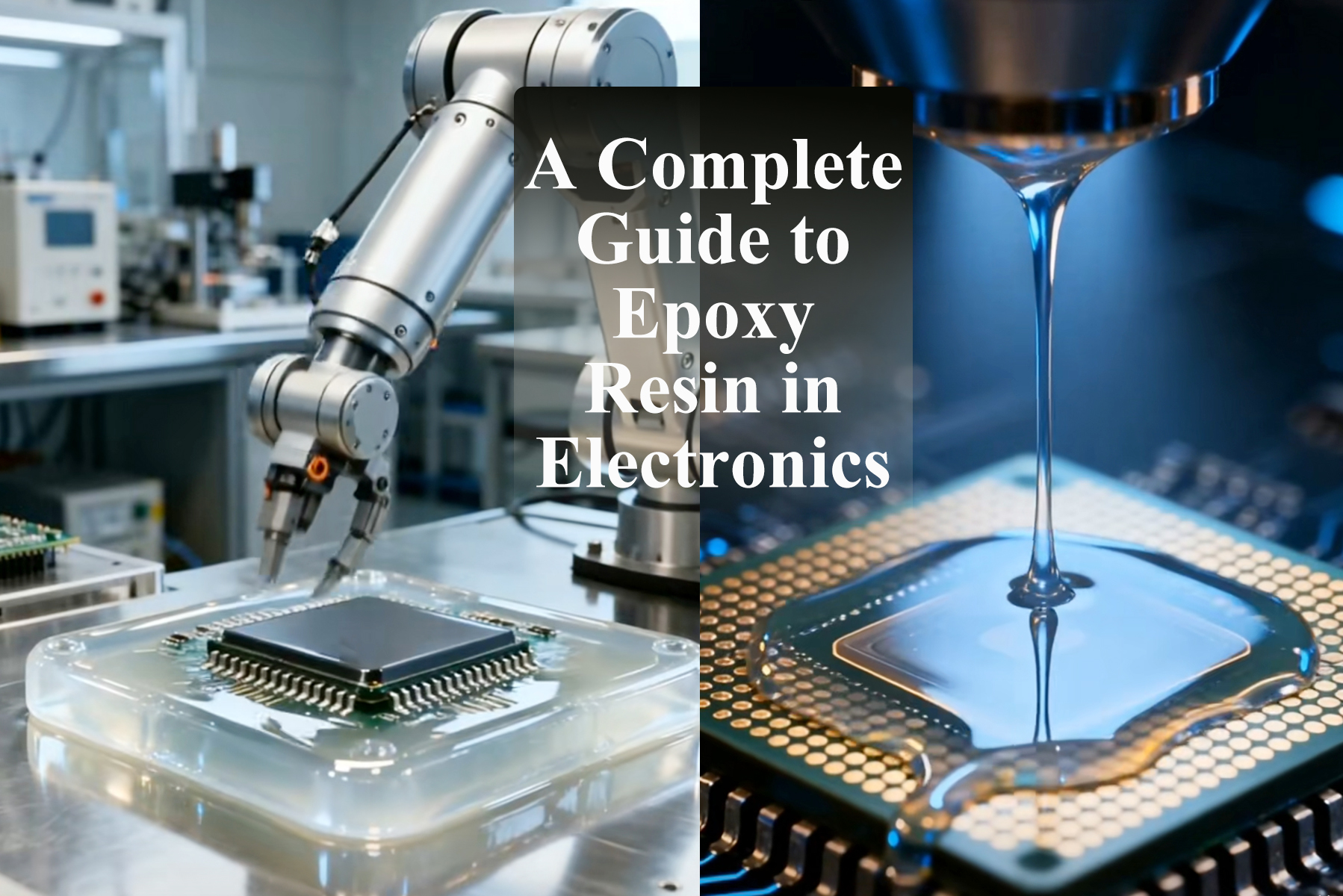
Epoxy is perfect for potting (encapsulating) sensitive parts like:
Rectifiers and transformers
Sensors and switches
Power supplies and modules
Potting protects against vibration, moisture, dust, and tampering.
2. Surface Coating (Conformal Coating)
Thin layers of epoxy are applied over PCBs, capacitors, resistors, and inductors. This surface p覆 (coating) prevents oxidation and electrical shorts while leaving the board functional.
3. Battery & Capacitor Sealing
Epoxy provides excellent adhesion to metals and plastics, making it a go-to choice for sealing:
Batteries (especially lead-acid and lithium packs)
Capacitors and inductors
4. Optoelectronics (LED & Display Industry)
In the photoelectric sector, epoxy resin is widely used for:
Encapsulating and bonding LEDs (light-emitting diodes)
Sealing digital tubes, pixel tubes, and electronic displays
Potting LED strip lights and modules
5. Structural Bonding in Electronics
Epoxy is also used to bond housings, heat sinks, magnets, and other structural components inside electronic devices.
Beyond Electronics: Other Industries Using Epoxy (For Context)
While this article focuses on electronics, it’s worth noting that epoxy is also heavily used in:
Hardware & sports equipment (badges, fishing rods, tennis rackets)
Construction (bridge coatings, floorings, civil engineering repairs)
Composite materials (carbon fiber bonding, wind turbine blades)
Art &antique restoration
Safety Precautions When Using Epoxy on Electronics
Even though epoxy is safe for electronics, it requires careful handling.
✅ Do:
Wear rubber or nitrile gloves to avoid skin contact.
Work in a well-ventilated area (fumes can be irritating).
Keep away from open flames or sparks (some hardeners are flammable).
❌ Don't:
Don’t touch the mixed epoxy with bare hands – it can cause skin sensitization over time.
Don’t ignore spills – clean small spills with soap and water.
Don’t pour large spills down the drain – use sand to absorb it and dispose of properly.
First Aid Tips:
On skin: Wash immediately with soap and water. Epoxy is not usually corrosive, but prolonged contact can cause dermatitis.
In eyes: Rinse generously with clean water for 15 minutes and seek medical attention.
If swallowed (rare): Do not induce vomiting – get medical help right away.
Final Verdict: Should You Use Epoxy on Electronic Components?
Yes, epoxy resin glue is not only safe but highly recommended for protecting and bonding electronic components. Its combination of electrical insulation, mechanical strength, moisture resistance, and thermal stability makes it a top choice for both DIY projects and industrial manufacturing.
Just remember to choose the right type of epoxy (potting, coating, or thermally conductive) and always follow safety guidelines.
Need epoxy dispensing equipment for high-volume production? Look for professional solutions from trusted suppliers like WEFILL.
Got a project in mind? Share your experience with epoxy and electronics in the comments below!